



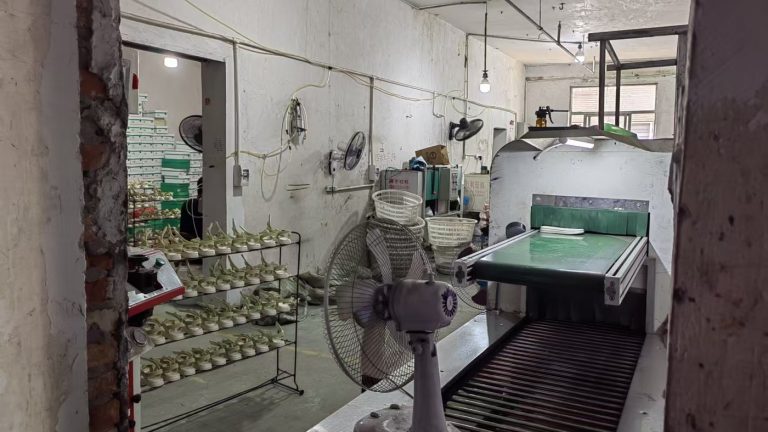
A workshop in Wenling, where shoes are still made by hand.
We are on Hengfeng Street in Wenling, Zhejiang — a town that has made footwear for generations. Thirty craftsmen, one building, and every step from cutting to packing done in-house.
China’s footwear capital
Wenling sits on the coast of Zhejiang, two hours south of Ningbo port. It has been a shoemaking town for decades, and that concentration is the reason we can do what we do: last makers, mould shops, leather merchants, hardware suppliers, heel and sole factories — almost everything a sandal needs is within a short drive.
For a buyer this matters in three practical ways. Sampling is fast, because a pattern maker can walk materials across town the same morning. Small quantities are possible, because we are not waiting on a container of one material from another province. And when something goes wrong mid-production, it gets fixed in days rather than weeks.
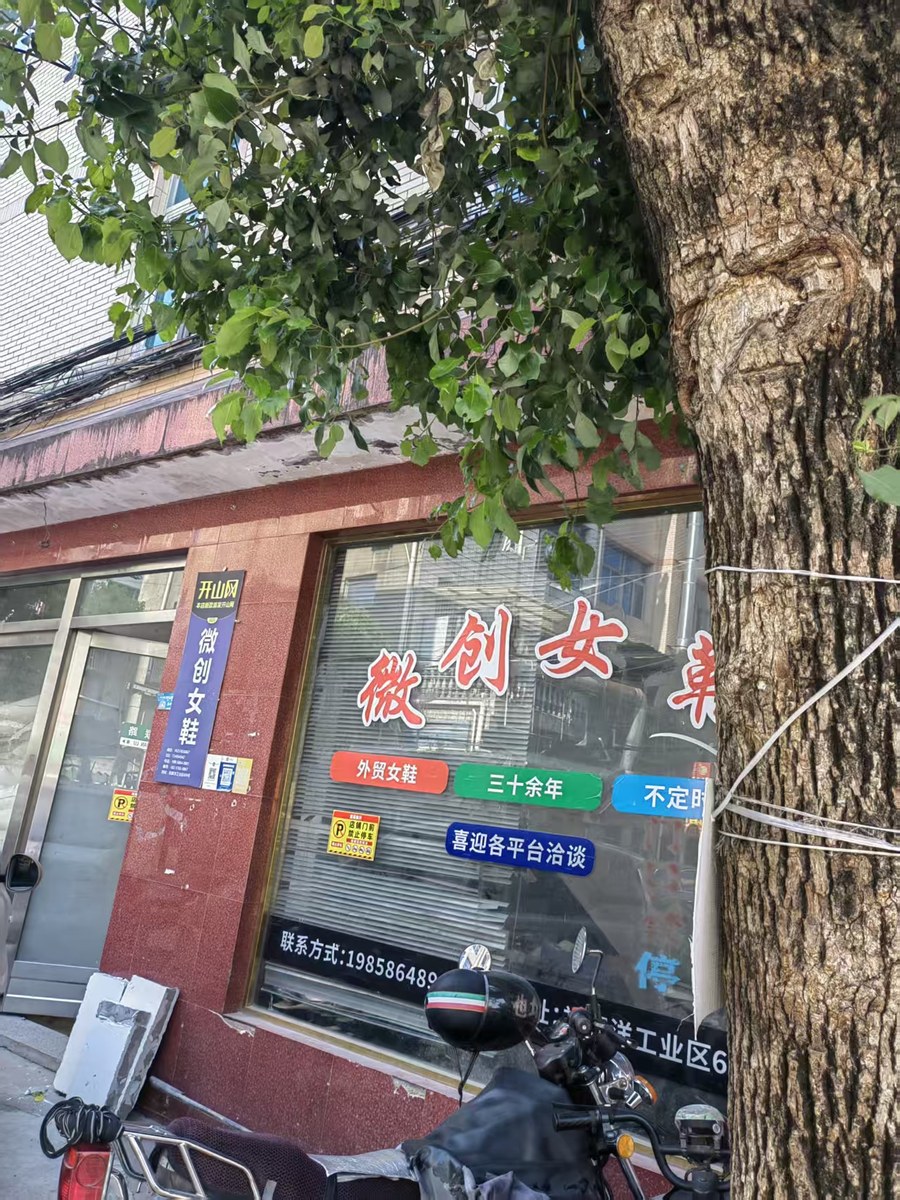
Our building sits in the Zhujiayang Industrial Zone. Buyers are welcome to visit — Ningbo Lishe and Wenling Airport are both practical arrival points, and we will collect you.
How a pair moves through the workshop
Seven stations, all in the same building. A pair typically spends between three and five working days moving from the cutting table to a sealed carton.
Pattern making and development
Every new style starts here. The pattern maker translates a drawing or a reference pair into a set of cutting patterns and grades them across the size run. This is the station that determines whether a shoe fits well, and it is where the most experience sits.
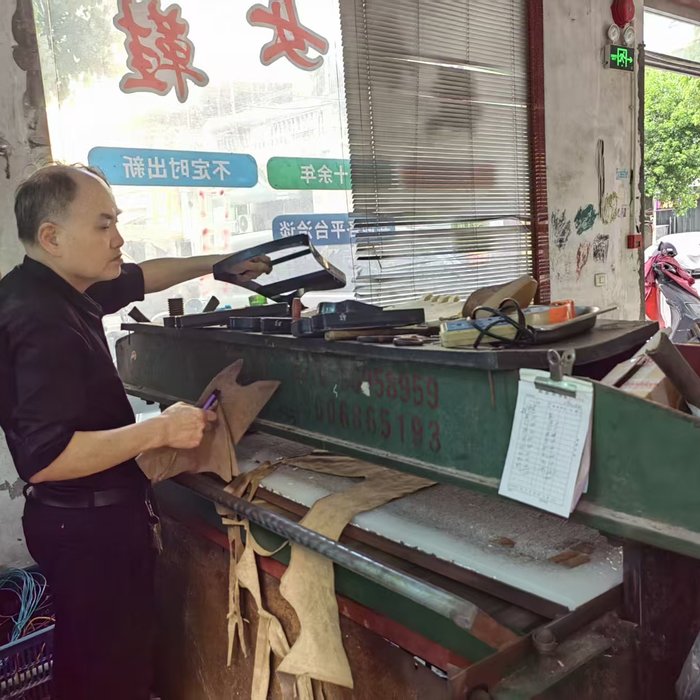
Material cutting
Uppers, linings and insole boards are cut by hand and by clicking press. Leather is read for grain direction and natural markings before the knife goes down — two hides are never identical, and a good cutter places the pattern so the visible panels are the cleanest part of the skin.
Preparation and skiving
Edges are skived thin, folded and cemented so seams sit flat against the foot. Skip this and the shoe looks acceptable on a shelf but rubs after an hour of wear.
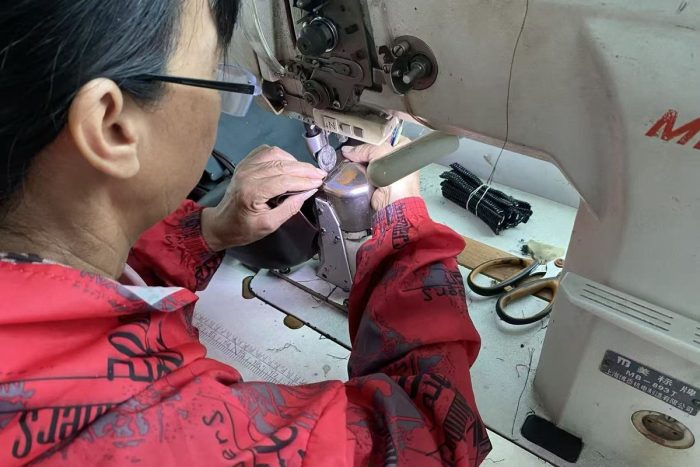
Stitching
Uppers are assembled on industrial machines. Straps, trims, buckles, rhinestone panels and raffia braid are attached at this stage. Thread ends are locked off rather than trimmed short, which is the difference between a seam that holds for years and one that unravels from the end.
Lasting and shaping
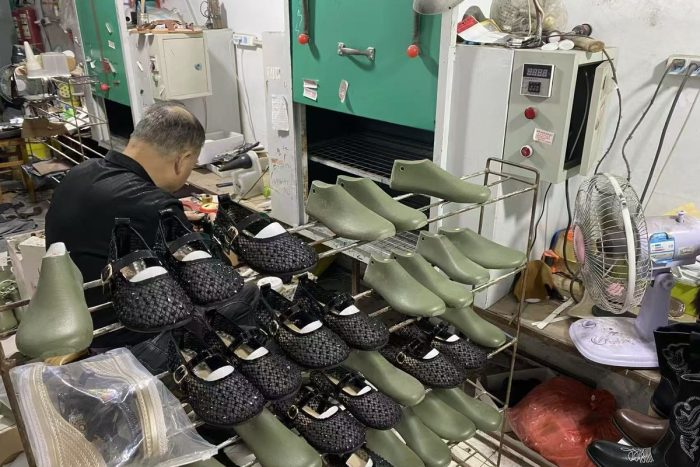
The upper is pulled over the last and held while it takes its shape. This is the step that gives a shoe its line. Done impatiently, the toe pulls off-centre and no amount of finishing hides it.
Soling and finishing
Outsoles, wedges and heels are roughed, cemented, pressed and set. Edges are trimmed and burnished, insoles fitted, and the pair cleaned of adhesive residue and loose thread.
Inspection, pairing and packing
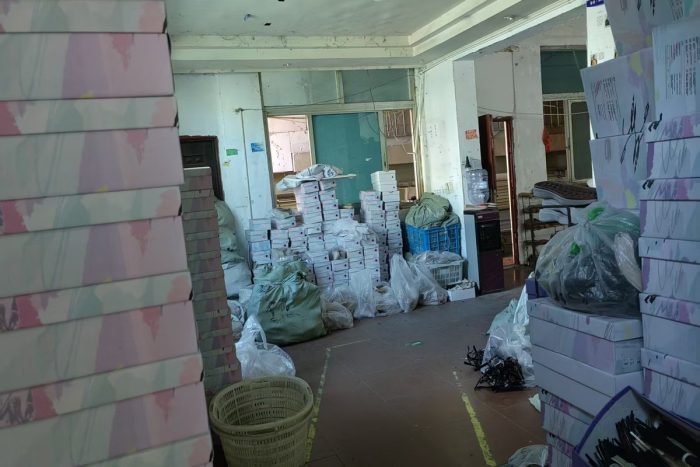
Each pair is checked against the sealed sample, matched left to right, wrapped, boxed and cartoned with your markings. Inspection photographs go out to you before the goods leave the building.
The people and the stations
Cutting Room
Stitching Line
Lasting & Soling
Inspection & Packing
Product scope and order capacity
We are a women’s footwear workshop with a deliberately narrow focus. We would rather make three categories properly than ten badly.
| Category | Typical construction | Heel range | Lead time at 300 pairs |
|---|---|---|---|
| Sandals | Cemented, wedge and flat | Flat to 90 mm wedge | 20–30 days |
| Slippers & mules | Cemented, open back | Flat to 70 mm | 15–25 days |
| Flat shoes | Cemented, closed toe | Flat to 25 mm | 20–30 days |
| Heeled sandals | Cemented, block and stiletto | 50–100 mm | 25–30 days |
What we work with
Genuine leather, microfibre and PU uppers, textile and raffia, rhinestone and hardware trim. Outsoles in TPR, EVA and rubber; cork and covered wedges; wrapped block heels.
Size runs
EU 34–43 as standard, with US and UK grading available. Full size runs, half sizes on request, and custom ratios per carton. See the Size Guide.
From 30 pairs upward
Thirty pairs per style and colour is our minimum. Most repeat customers sit between 300 and 1,000 pairs per style. Larger runs are quoted per order.
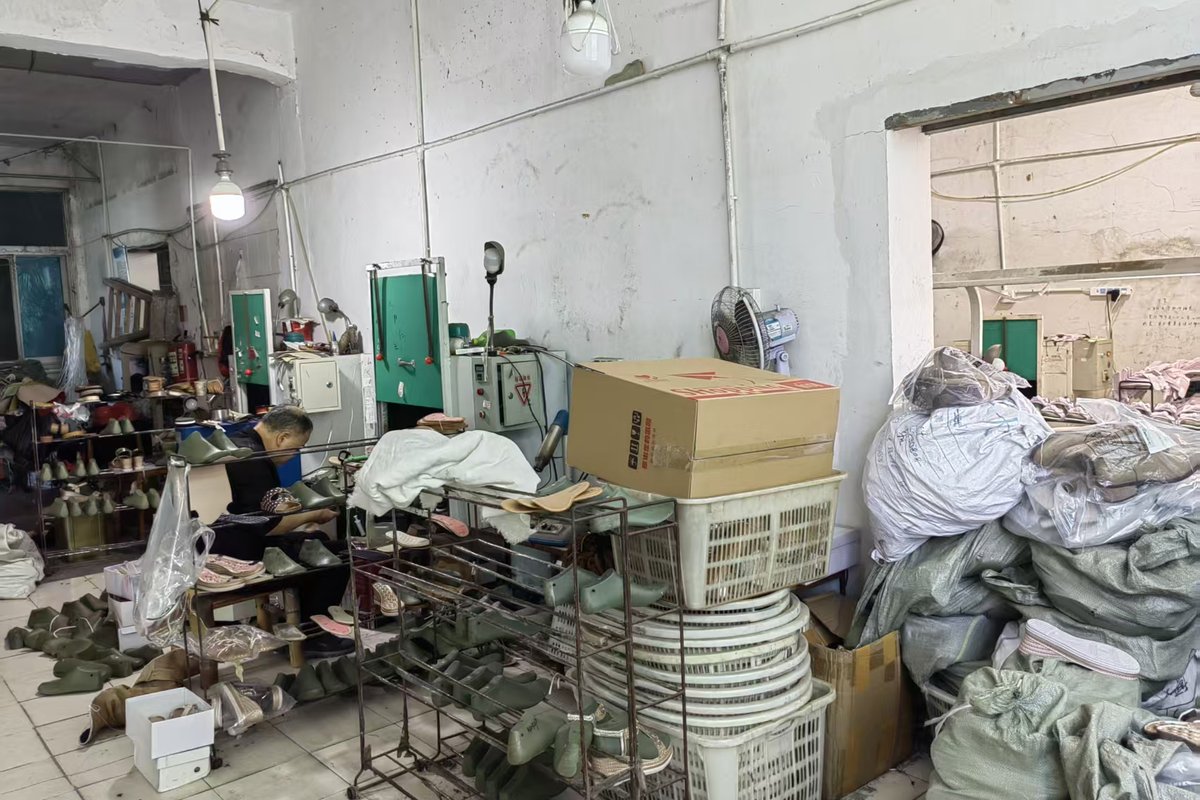
Machines are faster. Hands are better at the hard parts.
Much of a shoe can be automated, and where automation is genuinely better we use it — clicking presses, industrial stitching, sole presses. But the steps that decide whether a shoe looks expensive are still judgement calls: how a hide is read before cutting, how much tension goes into the lasting pull, where a rhinestone panel sits so it catches light without catching a thread.
Those decisions are made by people who have been making shoes for twenty or thirty years. It is slower, and it is the reason a mid-range pair from a small workshop can look considerably better than its price suggests.
We welcome buyer visits and third-party factory audits. Tell us roughly when you are in China and we will arrange the schedule and collect you from the airport or station.
Our location
Hengfeng Street, Wenling,
Zhejiang, China
Bring us a style and we will show you how it gets made.
Whether you are ordering thirty pairs or three thousand, the same craftsmen build it and the same people answer your emails.
